

A wrapper for the indicspecies::multipatt() function in the case of
physeq object.
Usage
multipatt_pq(
  physeq,
  fact,
  p_adjust_method = "BH",
  pval = 0.05,
  control = permute::how(nperm = 999),
  ...
)
Arguments
- physeq
(required) a
phyloseq-classobject obtained using thephyloseqpackage.- fact
(required) Name of the factor in
physeq@sam_dataused to plot different lines- p_adjust_method
(chr, default "BH"): the method used to adjust p-value
- pval
(int, default 0.05): the value to determine the significance of LCBD
- control
see
?indicspecies::multipatt()- ...
Additional arguments passed on to
indicspecies::multipatt()function
Details
This function is mainly a wrapper of the work of others.
Please make a reference to indicspecies::multipatt() if you
use this function.
Examples
# \donttest{
if (requireNamespace("indicspecies")) {
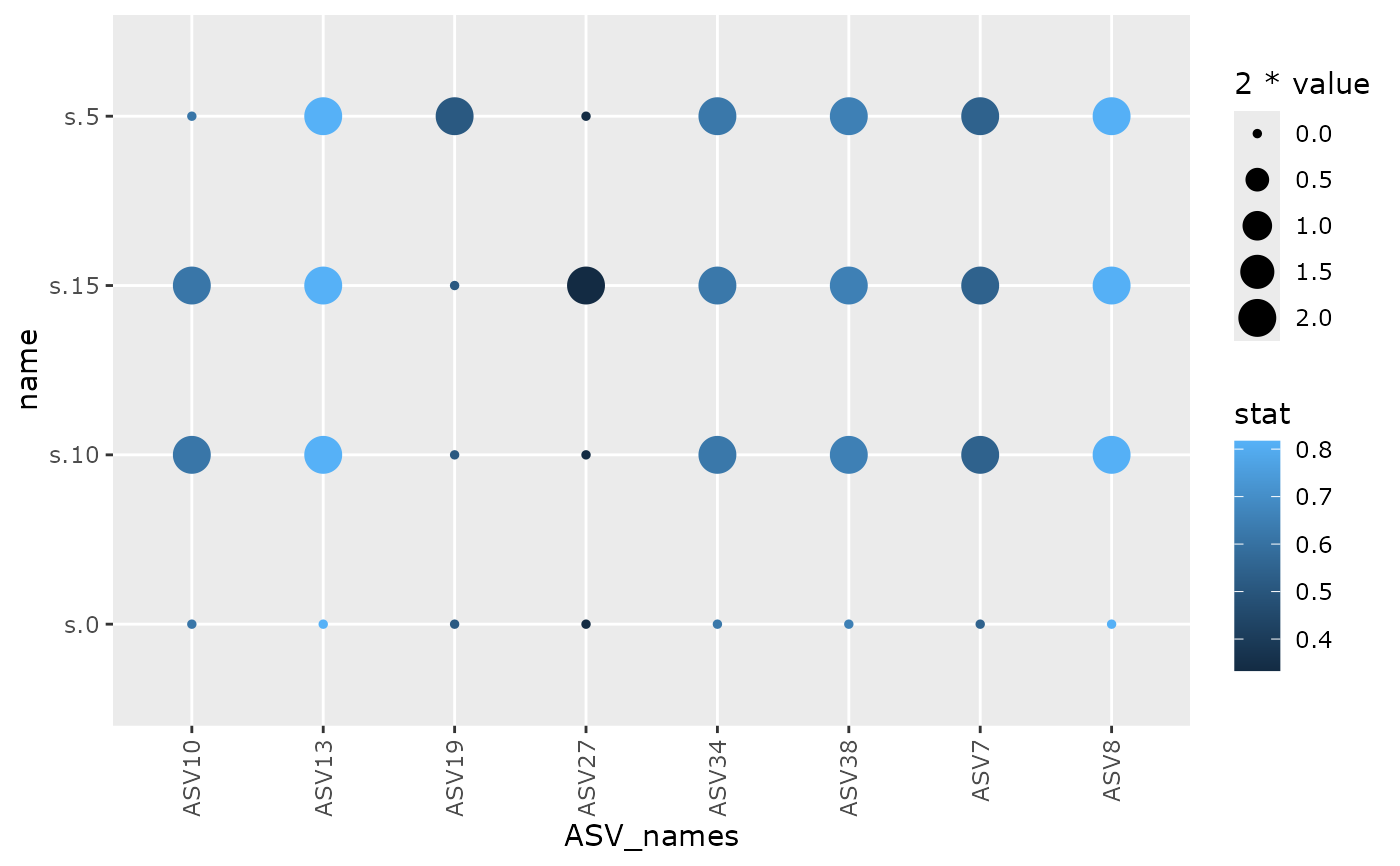
multipatt_pq(subset_samples(data_fungi_mini, !is.na(Time)),
fact = "Time", control = permute::how(nperm = 99)
)
multipatt_pq(subset_samples(data_fungi_mini, !is.na(Time)),
fact = "Time",
max.order = 1, control = permute::how(nperm = 99)
)
}
#> Taxa are now in columns.
#> Taxa are now in columns.
 # }
# }